Pressure Fighter
I wanted something that would be undeniable.

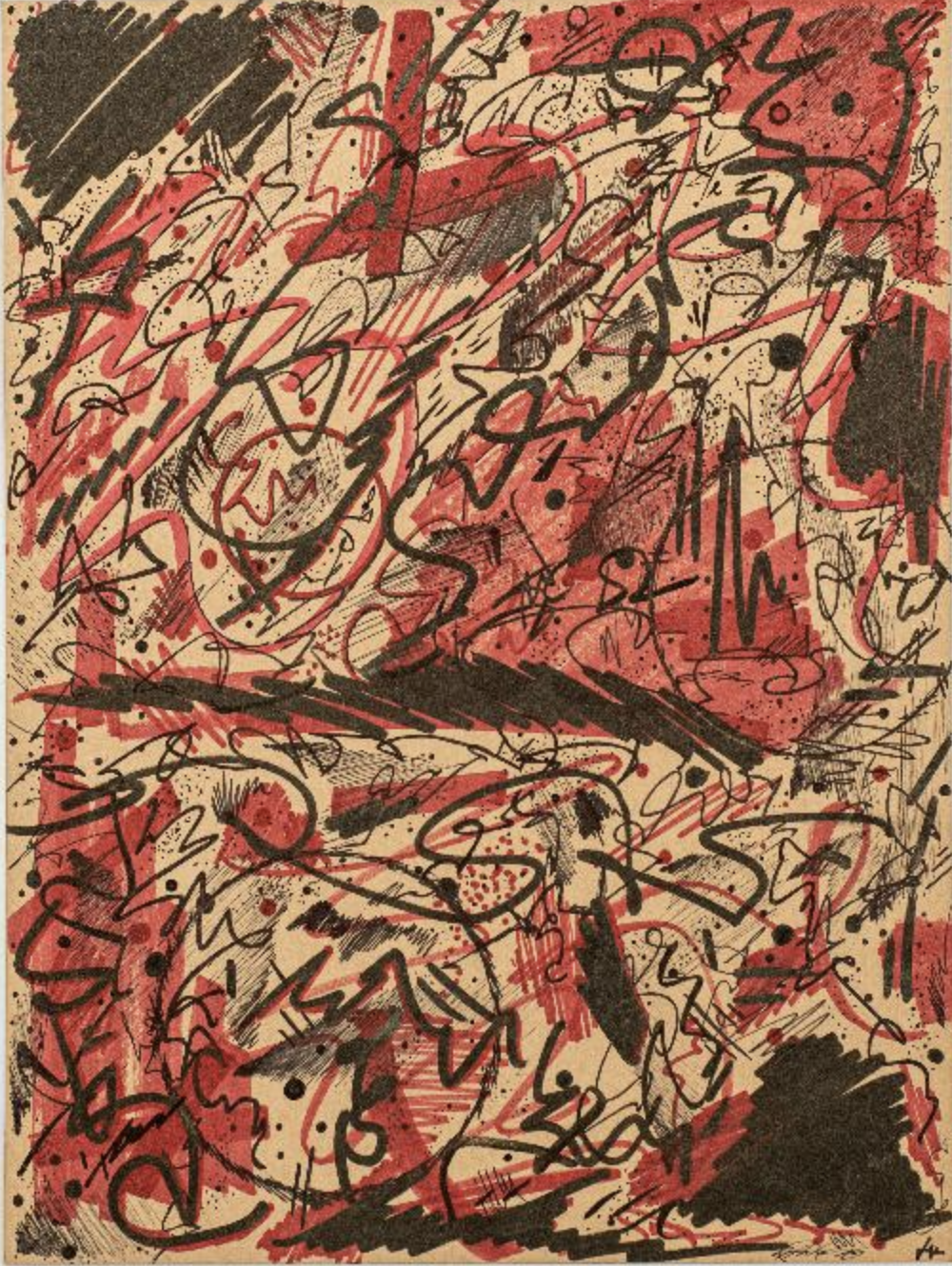
I asked Victor Tellez a relatively vague question: “Why do you choose shapes and squiggles?” Instead of being offended, he knew right away what I was asking: Why choose abstract over realism or other genres of fine art?
“Most of the time art is seen as a skill expression. I wanted something that would be undeniable, that even if they looked at it and didn’t appreciate the skill…” and this sentence basically had no resolution.
Eventually we had our answer: “I want people to look at it, and whether or not they can understand it or whether or not they can identify the images or ideas, I want it to move them whether they want it to or not.”
Victor then made a point that resonated with the entire reason I started the Phlank micro-zine, that is, to preserve the mystery that surrounds a lot of great work without much regard, if any, to monetary value or gain. “People have a tendency to try to squeeze every dime out of everything. Seemingly, nothing is content to exist under the radar. It has to do something – open a door to money, or be perceived as culturally significant. If it’s not culturally significant, it doesn’t matter. What a shame. In a lot of ways, this kills things that are really beautiful.”
He continued, “There’s something so powerful about taking away the context of something like visual cues, and just kinda sneaking in the things that I want to see.”
As artists feel more pressure to post on social media, they get deprived of an authentic art experience. I had been thinking about this for a while but hadn’t really vocalized it much. I knew then we’d be good friends.
Victor and I discussed the power of emotion in art. “I know that I want to invoke particular feelings. I know that I want to create specific experiences for my viewer and for myself…To do that without an image that you can easily read is a particular challenge, and it’s one that I really, really enjoy coming forward and taking on.”
I’ve been in my share of fights, just being bombarded, having something kind of come over you and not want to stop.
Very few of the emotional pressure cookers in life come close to sports. Victor is a wrestler. He explained, “One of my favorite pieces is also one of the most unpleasant to look at. It’s titled ‘Pressure Fighter.’ It’s about this very claustrophobic, intense experience that I’ve gotten in combat sports. I’ve been in my share of fights, just being bombarded, having something come over you and not want to stop.
I asked him if this feeling ever came over him off the mat. “The emotion is always the same. That tenseness in the chest, the desire to shell up and cower and hide and wait for something to be over.”
We agreed that it was a universal feeling. We’ve both had the feeling at work, in social situations, and in creative spaces.
I asked Victor if he feels confident that he can create a piece that is just an emotion. He clarified, “I want my work to connect those people that have different experiences but can say, “Oh, that’s what that felt like for you.”
“That is magical to me, to be able to say, ‘I had this experience totally different. You’ve never had it, but this is what it felt like.’ And someone else can go, ‘I’ve never had that, but I know that feeling.’”
To be able to say, “This is what it felt like.” And someone else can go, “I’ve never had that, but I know that feeling.”
I wanted to challenge him at this point, because I felt like he had his abstract approach down to a science. His technical ability is undeniable, as I had concluded by studying his work at length. That honestly was not the first thing that struck me. I had indeed felt that he was speaking a language without words. Each piece felt like a visual journal entry, shared with me directly.
We connected the most on our mutual appreciation forquality artisanship and craftsmanship. We bonded over the belief that just because technique is not the focal point, doesn’t mean that it should take a backseat during composition.
“[The viewer’s] own life gives them a lens that tends to a certain bias or something like that, which I have no control over. They do see certain things. Over time, I’ve been able to sharpen my tools so that I can do it with more precision.”